
Writers, bloggers, and marketers ask this question almost every day: “How many words do I need to write to rank in the #1 spot on Google?” It’s a fair question, especially now that Google’s results are influenced by AI, search intent, and new ranking systems that reward clarity and expertise.
If you’re looking for a straight answer, here it is: most top-ranking pages sit somewhere between 1,500 and 2,500 words. But the real story is more nuanced. Google doesn’t rank content just because it’s long. It ranks content that genuinely satisfies the searcher, covers the topic in full, and earns trust signals like backlinks—often strengthened by support from a White Label Link Building Service that can consistently secure relevant, high-quality placements.
Let’s unpack what actually matters in 2025 — and how to decide the right length for your own article.
Why Word Count Matters (But Not in the Way People Assume)

Google has never said that word count is a ranking factor. There’s no minimum length required to land on page one. However, longer content tends to perform better for one simple reason: it usually provides a deeper, clearer, and more complete answer. When writers take the time to explain a topic thoroughly, they naturally incorporate more relevant context, more definitions, more examples, and more supporting details. All of this helps Google’s algorithms understand the content better.
Longer pages also tend to keep readers around longer, which signals engagement. And because thorough content is much easier to cite in articles, posts, and research pages, it tends to attract more backlinks—something Google still takes very seriously.
In short, word count helps because it creates the conditions for better SEO signals, not because the number itself carries any weight.
What Studies Say About Ideal Length
SEO research from Ahrefs, Backlinko, SEMrush, and other major platforms consistently shows that pages ranking in the #1 position are often in the 1,800–2,500 word range. These aren’t rigid rules; instead, they’re averages drawn from millions of search results. The pattern is clear: pages with depth tend to rank higher because they answer more questions and anticipate more user needs.
This doesn’t mean you should write endlessly just to hit a quota. In fact, Google has become extremely strict about fluff. If your content feels padded, repetitive, or mechanical, it works against you. What Google really wants is substance — not length for the sake of it.
How Much You Should Write Depends on the Search Intent
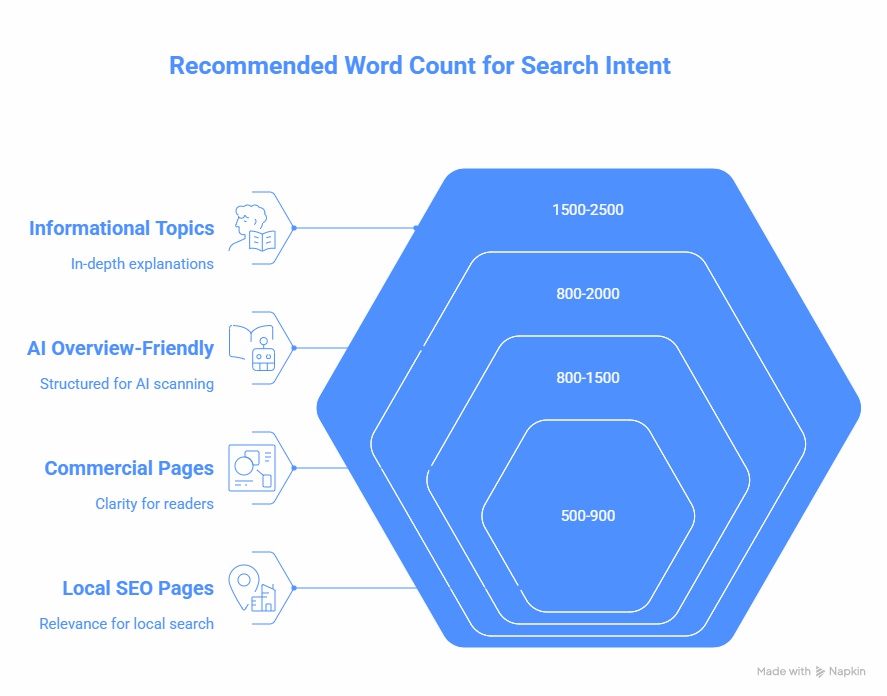
Different search queries demand different levels of explanation. This is why the “right” word count changes depending on what users want.
For informational topics—guides, how-to articles, explanations, writing help, SEO breakdowns, and similar content—Google expects a fuller, more in-depth answer. These topics usually perform best in the 1,500–2,500 word range. You’re essentially educating the reader, which requires space to explain concepts clearly.
Commercial pages, such as product comparisons, reviews, and “best of” lists, don’t usually need as much depth. These pages typically fall closer to the 800–1,500 word range because readers want clarity, not a long-winded lecture.
Local SEO pages are even shorter. A local service page that answers basic questions about a business doesn’t need more than 500–900 words. Google wants relevance there, not volume.
Then there’s AI Overview–friendly content. These articles prioritize structure, short paragraphs, lists, and entity clarity. They usually fall around 800–2,000 words, depending on the depth of the topic. They don’t need to be ultra-long; they simply need to be structured in a way that makes it easy for AI models to scan and extract meaning.
Why Word Count Alone Will Never Get You to the #1 Position
There’s a hard truth in SEO that hasn’t changed: you can write the most detailed, beautifully structured article, and it still might not rank if your domain lacks authority. In competitive niches, authority matters just as much as content.
Authority in Google’s eyes comes primarily from backlinks—links from other websites that vouch for your page. When respected sites link to your content, Google treats it like a vote of confidence. The more authoritative the linking sites are, the stronger that vote becomes.
This is why two articles of the same length and quality can perform dramatically differently. The one with strong link-building behind it will outrank the one without any external validation. Ahrefs’ research has shown time and again that the page ranking #1 typically has several times more backlinks than the pages sitting below it.
Backlinks don’t just help rankings; they also speed up indexing and help Google understand where your content fits within a topic cluster. When multiple related pages across your site earn links, you build topical authority, which strengthens everything else you publish.
This is why many SEO experts say that a well-written 1,500-word article with solid backlinks—often supported by a strategic link building SEO company—will always beat a 3,000-word article that sits alone without any link support.
A Simple Way to Determine Your Ideal Word Count
Instead of guessing, you can quickly figure out the right length for any keyword by following a straightforward process.
Start by searching your target keyword on Google and opening the top three results. These are your benchmarks, because they represent what Google currently considers the best answer. Scan the pages and get a sense of their length. You don’t need an exact number; even a rough estimate gives you direction.
Once you have an idea of the average length, aim to match that depth while adding 10 to 20 percent more clarity, context, or helpful information. This doesn’t mean adding more words. It means adding more value.
Make sure your article includes strong internal links that connect it with the rest of your relevant content. This helps both users and Google navigate your site.
Finally, plan to build at least a handful of contextual backlinks. Even three to five well-placed links from relevant sites can dramatically shift your ranking potential, especially for new or medium-authority domains.
When you combine a solid word count with structure, clarity, internal links, and external authority, ranking becomes significantly easier—even in competitive spaces.
Word Count Expectations for Different Content Types
Although there’s no official rulebook, the industry has settled into fairly reliable ranges for different types of content. Quick answers or definitions tend to fall between 300 and 600 words. Student-focused questions—like page count or paragraph count queries—usually land in the 600–900 word range. Blog guides tend to rank best when they sit between 1,500 and 2,500 words, while comprehensive “ultimate guides” often reach 3,000 to 5,000 words.
Tool or product pages typically fall in the 500–900 word range, and comparison articles sit somewhere around 800 to 1,600 words. Content designed for AI Overviews generally performs well between 800 and 2,000 words, as long as it is structured cleanly and written with semantic clarity.
These ranges aren’t requirements; they’re simply patterns derived from what currently works.
Mistakes That Can Hold Your Content Back
Writers often worry about hitting the right number of words but overlook the more meaningful issues that affect rankings. One common mistake is writing too briefly in a competitive space. If the top-ranking pages offer thorough explanations and yours barely scratches the surface, you simply won’t compete.
Another mistake is the opposite extreme—adding filler content just to hit a certain word count. Google is quick to flag content that feels repetitive or bloated, especially now that the Helpful Content updates are more active.
A lack of structure also hurts performance. Big blocks of text are hard for both readers and search engines to digest. Weak introductions cause readers to bounce, which signals dissatisfaction. And even the best-written pages struggle to rank if they don’t have backlink support.
A surprising number of pages also fail to answer the primary question directly. Google and readers both expect a clear answer early in the article. If your reader has to hunt for it, you’re losing ground.
So How Many Words Do You Actually Need to Rank #1?
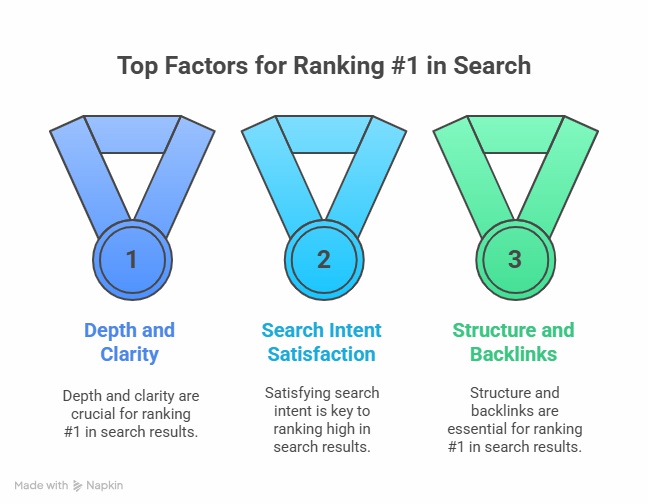
After looking at thousands of rankings and studies, the most realistic answer is this: most #1 pages fall between 1,500 and 2,500 words, but they rank because they deliver depth and clarity—not because of the number alone. A shorter article can rank if the topic is simple or low-competition, and a longer article may be necessary when the topic is broad or nuanced.
What matters far more is how well you satisfy the search intent, how clearly you explain the topic, how well the content is structured, and whether the page has earned strong backlinks.
If your article checks all of these boxes, you’re already ahead of most of your competitors.
Word count is a useful guide, but it’s not a rule. Most winning pages aim for thoroughness rather than length. In 2025, the pages that perform best are the ones that truly help readers, are organized in a way that AI and humans can understand, and have the kind of backlink authority that signals trust.
If you focus on depth, structure, internal linking, and link-building support—and pair that with a clean, reader-friendly writing style—ranking #1 becomes far more attainable, regardless of the exact number of words you write.